
Lichtman's Model
He forgot about inflation

The dust is settling after the American election and the standard round of recriminations is underway. This year both the polling vendors and the forecasters are getting a good share of the criticism. As ever the problem faced by the pollsters is that of finding a method for sampling voters that avoids bias. This is already a difficult challenge and, as it turns out, is almost impossible for a deeply divided but politically fluid American electorate. For the forecasters the equivalent problem is to devise a method of assigning probabilities in their models that is similarly unbiased. These are hard problems. One of the ways to deal with hard problems is to re-frame the question you are asking in a way that avoids them. This is what the historian Allan Lichtman did with his famous '13 keys model' which is often advertised as having 'successfully predicted nine of the last eleven elections'. That model failed this year, and I want to use this blog to think about why it did. Now, having said that the dust has started to settle, it is also clearly still radioactive, and I have no interest in kicking it up again. If there is such a thing as political science then that implies that political phenomena can be observed objectively. That is what I intend to do here; let's see if I succeed.
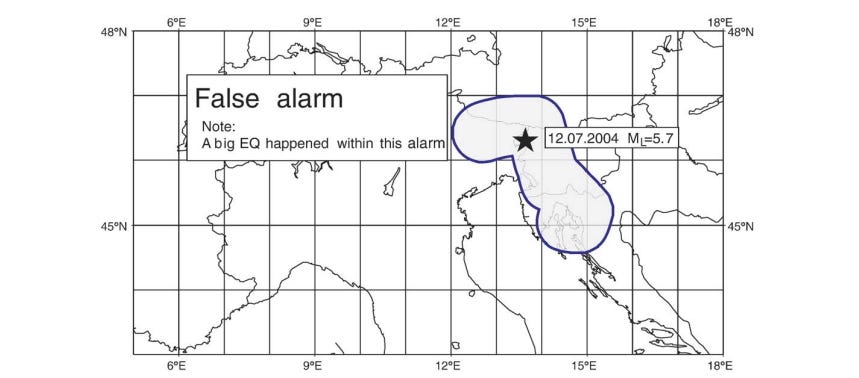
The first thing to say is that the history of the model is more interesting than it initially appears. Lichtman is usually presented as the owner of the 'keys' but in truth he is its co-creator and current custodian. The idea behind the model originally came from the Russian geophysicist Vladimir Keilis-Borok, with whom Lichtman wrote an influential paper on pattern recognition in American Presidential elections in the 80’s. At the time Keilis-Borok was still working on the other side of the iron curtain at the University of Moscow, though he would later move to the faculty of Earth and Space Sciences at UCLA. He had become interested in the statistical problem of 'rare extreme events' which were not 'predictable in the Laplacean sense'. In other words, he wanted to test the extent to which we could successfully forecast the behaviour of systems for which we lack (and may never find) a complete set of fundamental equations. In an interview shortly before the 2008 election, which the model successfully predicted, Keilis-Borok explained that his approach to elections was similar to that used in earthquake prediction:
"The systems that generate elections and earthquakes are complex systems," said Keilis-Borok, […] "They are not predictable by simple equations, but after coarse-graining -- averaging -- they become predictable."
‘In the Quake Model, Rumblings Favour Obama’, Washington Post, 24 August 2008
He applied these ideas to a range of 'rare phenomena of highly complex origin', some of them economic, including shifts in the rate of unemployment and recessions. In each case the methodology was basically identical, using a simple algorithm to perform a search for the typical pattern of traits that are 'premonitory' for the target phenomenon. The algorithm is then trained to measure the 'Hamming distance' between the event being forecasted and the ideal pattern or 'kernel' of such traits. For American Presidential elections, this 'kernel' represents the set of indicators that would signal a win for the incumbent (I). The further the election under analysis is from that kernel in terms of its Hamming distance, the more likely it is that the challenger (C) will win. All that matters is whether 'I-coded or' 'C-coded' signals preponderate in the final analysis. Unlike probabilistic models, the tightly parametrised 'Keys' system has a binary output or what Keilis-Borok elsewhere calls a '0/1 alarm'.
Initially, Lichtman and Keilis-Borok proposed 12 parameters, with a further parameter being added after running additional trials with the data. The canonical list of keys, which Lichtman has used ever since, is presented in his book The Keys to the Whitehouse :
1. Incumbent-party mandate: After the midterm elections, the incumbent party holds more seats in the U.S. House of Representatives than it did after the previous midterm elections.
2. Nomination contest: There is no serious contest for the incumbent-party nomination.
3. Incumbency: The incumbent-party candidate is the sitting president.
4. Third party: There is no significant third-party or independent campaign.
5. Short-term economy: The economy is not in recession during the election campaign.
6. Long-term economy: Real annual per capita economic growth during the term equals or exceeds mean growth during the two previous terms.
7. Policy change: The incumbent administration effects major changes in national policy.
8. Social unrest: There is no sustained social unrest during the term.
9. Scandal: The incumbent administration is untainted by major scandal.
10. Foreign or military failure: The incumbent administration suffers no major failure in foreign or military affairs.
11. Foreign or military success: The incumbent administration achieves a major success in foreign or military affairs.
12. Incumbent charisma: The incumbent-party candidate is charismatic or a national hero.
13. Challenger charisma: The challenging-party candidate is not charismatic or a national hero.
A lot of the flack that Lichtman has been getting concerns the amount of subjective tinkering needed to calibrate the keys. Even on a cursory reading it is obvious that at least half the parameters require some degree of judgment to 'turn'. That judgment is provided by Lichtman himself who, like the rest of us, has his own biases. Some of his judgment-calls this year were surprising, to put it mildly. For example, he refused to grant key 13, on challenger's charisma, to Donald Trump, and confidently gave Key 10, concerning military failures, to the incumbent. Even if he had good reasons for doing so, one could present equally forceful arguments for calibrating the model in the opposite direction. This is a weakness that Lichtman has never really been able to address.
However, I want to ignore the 'subjectivity' problem and think about what can be done within the Lichtman-Keilis-Borok framework to improve the model. What this really boils down to is asking whether there any 'simple integral parameters of the common-sense type' which Lichtman searched for that may have been omitted? Reading through the original papers co-authored with Keilis-Borok, as well as the explanatory spiel Lichtman provided for his 2024 prediction, there does seem to be one such omission. The economic keys (5,6) do not mention inflation. Key (6) does include a 'real' variable which may capture some of the inflation effect, but I think there would be good arguments for adding an independent 'inflationary event' key, such is the powerful effect that price volatility can have on the fundamental texture of economic and social relations.
In one of his early papers on economics entitled 'British Crisis' (1947) the Hungarian polymath and part-time economist Michael Polanyi wrote that 'the intellectual task that modern society has shouldered by committing its welfare to the use of a circulating stream of money is no doubt a very difficult one'. From time to time this task has shown itself to beyond our control, resulting in periods of sustained price rises. In some modern developed economies this is a vanishingly rare occurrence; other economies rarely enjoy any substantial period of normal monetary conditions. Probably the single most incisive analysis of effects of inflation on welfare was provided by John Maynard Keynes in a memorable passage in The Economic Consequences of the Peace (1919):
Lenin is said to have declared that the best way to destroy the Capitalist System was to debauch the currency. By a continuing process of inflation, governments can confiscate, secretly and unobserved, an important part of the wealth of their citizens. By this method they not only confiscate, but they confiscate arbitrarily; and, while the process impoverishes many, it actually enriches some. The sight of this arbitrary rearrangement of riches strikes not only at security, but at confidence in the equity of the existing distribution of wealth. Those to whom the system brings windfalls, beyond their deserts and even beyond their expectations or desires, become "profiteers,", who are the object of the hatred of the bourgeoisie, whom the inflationism has impoverished, not less than of the proletariat. As the inflation proceeds and the real value of the currency fluctuates wildly from month to month, all permanent relations between debtors and creditors, which form the ultimate foundation of capitalism, become so utterly disordered as to be almost meaningless; and the process of wealth-getting degenerates into a gamble and a lottery. Lenin was certainly right. There is no subtler, no surer means of overturning the existing basis of society than to debauch the currency. The process engages all the hidden forces of economic law on the side of destruction, and does it in a manner which not one man in a million is able to diagnose.
J M Keynes, The Economic Consequences of the Peace, New York, Harcourt, Brace and Howe, 1920
One of the other ways inflation 'engages the hidden forces of economic law on the side of destruction' is through the strange effect it has on the way economic agents relate to time. This has been beautifully described by Axel Leijonhufvud in his book High Inflation (1995), which was co-authored with the Argentine economist Daniel Heymann. A neat resume of those ideas is given in Leijonhufvud's paper 'Macroeconomics and Complexity: Inflation Theory' (1997). Here is his arresting description of the effects of the inflationary spike in the US in the 1970s:
'American readers may recall that the very moderate inflation in the United States in time 1970s saw the disappearance of the market for 30-year bonds and the virtual demise of the 30-year fixed-rate mortgage. That moderate inflation never exceeded 15% per year. Higher inflations will kill off markets for far shorter maturities. In Argentina in 1985, the longest nominal rate maturity was 45 days-and that was a thin market. Typical trade credit was 7 days, not the 90 days that are normal in stable circumstances. A foreshortening of temporal perspective is "built into" the definition of high inflation from which we started. But the all but total lack of temporal depth of the high inflation economy will nonetheless qualify as a "surprise" because standard monetary and finance theory do precisely nothing to prepare us for it.'
Axel Leijonhufvud, ‘Macroeconomic and Complexity: Inflation Theory’ in Santa Fe Institute Studies in the Sciences of Complexity, Vol. XXVII, New York: Addison-Wesley, 1997.
Leijonhufvud goes on to explain how the intensity of the 'temporal foreshortening' effect increases proportionally with the rate of inflation, 'extinguishing' markets with shorter and shorter maturities until the 'outbreak of true hyperinflation when many spot transactions are affected'. We are all familiar with the stories of how during the post-war inflation in Germany simple transactions would involve the exchange of wheelbarrows full of deutschmarks. Likewise in Argentina during the explosive hyperinflation of the late 1980s shops were known to put up signs reading 'closed for lack of prices'. Under such conditions it is impossible to perform the sort of 'intertemporal optimisation' that, according to classical economic theory, characterises the behaviour of rational economic agents. The horizon over which such decision are made has been erased:
'High inflation, contrasted to "monetary stability," is not simply a mean-preserving increase in variance for an otherwise unchanged structural model. To the individual agent, increased complexity means rather that the model that he or she requires in order to predict the utility-relevant (future) outcome of a present action has more variables and requires knowledge of more parameters. This may occur, for example, as the result of a change in the monetary regime. When the regime changes, the true specification of the novel system structure will not be known to agents. They must try to infer it. But experience with the now more complex regime is brief. The "usable memory" is short and the "useful forecasts" will be equally so.'
Axel Leijonhufvud, ‘Macroeconomic and Complexity: Inflation Theory’ in Santa Fe Institute Studies in the Sciences of Complexity, Vol. XXVII, New York: Addison-Wesley, 1997
In the words of the poet, time is 'out of joint'. It is of course true that Leijonhufvud is describing an extreme form of inflation which is nothing like the moderate groundswell in prices that affected a number of western economies, including the US, earlier this year. But even a brief spell of inflationary pressure can be sufficient to set to work those same pernicious forces that Keynes describes, and which, as Leijonhufvud and Heymann show, can overturn the most basic patterns of economic behaviour. A small dose of such 'arbitrary destruction' can be sufficient to induce profound economic anxiety. In short, there are few things as destabilising for an incumbent political regime than inflation, even if it is eventually contained. I struggle to see how a model based on the recognition of simple 'premonitory patterns' of social, economic and political factors can do without a parameter that captures these effects. Inflation itself might be the looked for '0/1 alarm' that Keilis-Borok described.
One final comment. It should not be surprising that in periods of inflation most people will look for certainty above all else. And the most reliable source of certainty is the past. As the great historian Geoffrey Elton once said, in times of crisis when 'the future is dark, the present burdensome; only the past, dead and finished, bears contemplation.' This may explain in part why during a period of price volatility, evoking the past is a robust political strategy.
Criminally underrated account